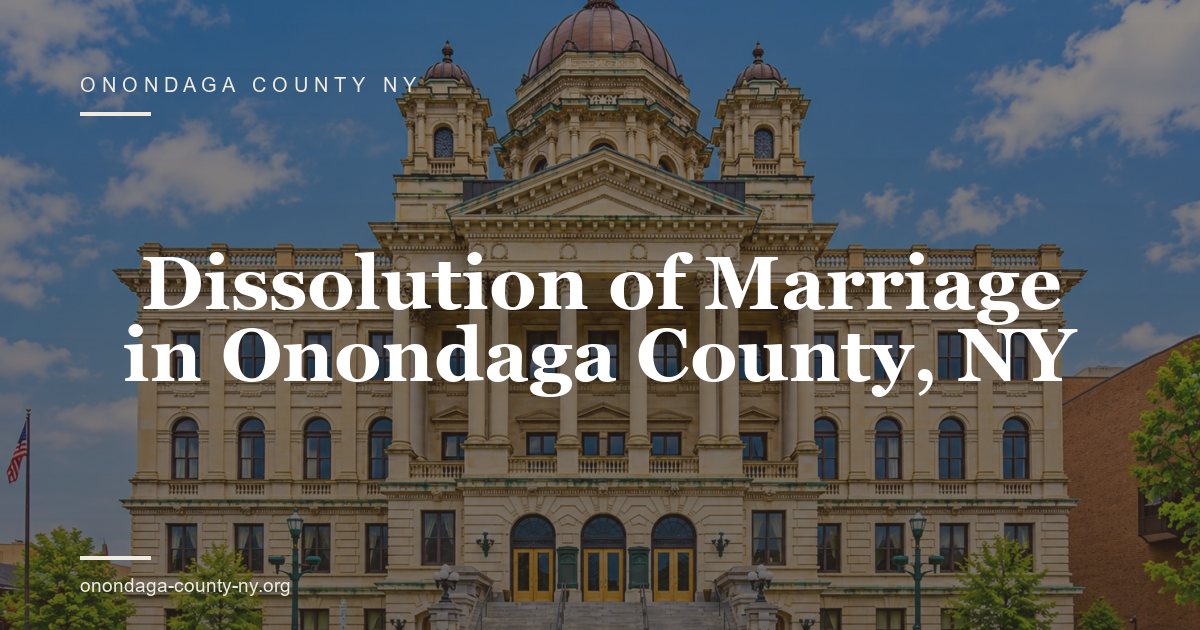


A dissolution of marriage is the end of a marriage by court order, and New York courts usually call the case a divorce or a matrimonial action. The Supreme Court hears these cases, and the Onondaga County Clerk holds the file at 401 Montgomery Street in Syracuse. This page shows how to find a file, request a certified copy, and check a record for errors. It is general information, not legal advice.
This page starts with Divorce Record Search and points to the Supreme Court and County Clerk that hold the file. Use the case number and court name, then confirm sealed records, copies, and fees with the clerk. A docket entry is an index, not a certified record.
Divorce Record Search
Use these key points and the official source below.
- Official source: https://onondaga.gov/clerk/
- Court office: Onondaga Supreme & County Courts, 401 Montgomery St, Syracuse, NY 13202.
- Start with: The full name of either spouse and the year the case started.
- Ask for: The index number, the judgment date, and the paper you need.
- Note: Files are public except when a judge seals them or a law limits them.
Filings, Decrees & Custody Terms
A divorce case starts with a summons and a complaint, or a summons with notice. The plaintiff files first, and the defendant answers. Both sides file a statement of net worth, and the court sets a schedule. Automatic orders take effect at filing and limit what either side can do with property, insurance, and the children. A judge signs the judgment at the end of the case.
| Paper | What it states | Typical filing stage |
|---|---|---|
| Summons and complaint, or summons with notice | The claims and the relief requested | Start of the case |
| Answer | The reply to each claim | After service |
| Statement of net worth | Income, assets, debts, and expenses | Early in the case |
| Request for Judicial Intervention | Asks the court to assign a judge | When court action is needed |
| Preliminary conference order | A schedule and interim terms | Early court stage |
| Stipulation of settlement | Terms both sides accept | Before judgment |
| Judgment of divorce | The end of the marriage and related terms | End of the case |
| Post-judgment order | Changes to support or custody later | After judgment |
The table lists papers in the order most readers meet them. Not every case has every paper. A case that settles may have no trial, and a case with a trial may have no settlement stipulation. Ask the clerk for the document list on the file before you order copies, and name the paper by its title and date.
Certified Divorce Decrees & Judgment Dates
New York uses the word judgment, not decree. The judgment of divorce states the grounds, the date the marriage ends, and the terms the court approved. A judge signs it, and the County Clerk enters it in the file. A certified copy carries the clerk’s seal and the date the clerk signed it. Other states often call that paper a divorce decree. The signature date and the entry date can differ.
Property Division & Spousal Support Logs
Property division in New York is called equitable distribution. The judge divides marital property and debts under state law, and the judgment or a settlement stipulation records the result. Spousal support is called maintenance. Paperwork can include statements of net worth, appraisals, account statements, and orders to transfer a retirement account. Some financial papers are sealed or redacted in divorce decree records, so a public file may not show every figure. Ask the clerk what the file holds.
Child Custody & Post-Divorce Modifications
Custody and parenting terms can be part of the divorce judgment. A parent who wants a change later files a modification petition in the court that issued the order. Supreme Court and Family Court can both hold custody and support papers, and each keeps its own file. A new petition gets a new number. Ask the clerk which court and which number hold the current order.
Public Availability & Official Copies
Most matrimonial files at the County Clerk can be viewed by the public, and some papers inside them cannot. A judge may seal a file or a single paper under state law. Records about children and financial details often carry limits, as do family court records. Online systems may list only the case caption and dates. The paper file at the clerk’s office in Syracuse remains the official record that controls.
| Office | Address | Phone | Official link | Best for |
|---|---|---|---|---|
| Onondaga County Clerk | 401 Montgomery St, Room 200, Syracuse, NY 13202 | (315) 435-2227 | https://onondaga.gov/clerk/ | Divorce files, index search, certified copies; Mon-Fri 8:30-4:00 |
| Onondaga Supreme & County Courts | 401 Montgomery St, Syracuse, NY 13202 | See official site | https://www.nycourts.gov/courts/5th-judicial-district/onondaga-supreme-county-courts | Judge, part, and court date questions |
| Onondaga Family Court | See official site | See official site | https://www.nycourts.gov/ | Custody, support, and Family Court dockets |
| New York Courts | See official site | See official site | https://www.nycourts.gov/ | Forms, rules, and statewide case information |
Call the County Clerk before a visit when you need a copy of an old judgment. The index search and the copy request are separate steps, and a file stored off site can take longer. The Supreme Court clerk answers questions about a judge or a court date. Family Court answers for its own docket. No clerk can give legal advice.
District Clerk Files & Search Logs
New York does not use the title district clerk for these files. The County Clerk acts as clerk of the Supreme Court in Onondaga County, and that office keeps the divorce file and the index. A search log is the index entry, not the file. It can show the names, the index number, and the filing year. The papers themselves need a separate written request.
Confidential Child Data & Sealed Records
A judge can seal a matrimonial file or one paper in it. State law keeps Family Court records confidential, and that covers custody and support cases filed there. Social Security numbers, account numbers, and details about minors are often redacted. A clerk can confirm that a file exists or that it is sealed. The clerk cannot show sealed papers without a court order. A sealed file still exists.
| Record | Rule | What the clerk can confirm |
|---|---|---|
| Sealed matrimonial file | Court order under state law | That the file is sealed |
| Family Court custody file | Confidential by law | Whether a release is allowed |
| Statement of net worth | May be sealed or redacted by order | Whether a public copy exists |
| Child support papers | Limited by law | The docket number and status |
| Papers naming a minor | Often redacted | That a redacted copy exists |
| File stored off site | Not sealed, just remote | That it can be retrieved |
The table groups the limits readers ask about most. A sealed file still exists, and a clerk can confirm its status without showing the papers. A request for sealed material needs a court order or a legal right to the record. Do not treat a missing online entry as proof that no case exists.
Certified Copies, ID Rules & Processing Fees
Ask the County Clerk for a certified copy of the judgment, not the whole file. Give the names, the index number, and the approximate year. The clerk finds the paper, copies it, and attaches a certification with a seal. The fee is set by law, and the clerk quotes it. Photo identification may be requested. Ask how long the work will take before you pay.
Record Accuracy & Resolution
A court file can hold an old address, a misspelled name, or a date that conflicts with another paper. Clerks correct clerical errors when a party shows the signed original. A dispute about what a judge ordered needs a motion or a lawyer. Third-party sites copy court data and can mix up two people with the same name. Confirm each fact with the clerk who holds the file.
| Problem | Common cause | Step that settles it |
|---|---|---|
| No result by name | Name spelled differently in the file | Search by index number or another spelling |
| Result for the wrong person | Same name, different person | Compare birth date and party names |
| Wrong court | Case filed in another county or state | Contact the clerk in that county |
| Recent filing absent | Papers not yet indexed | Give the clerk the stamped filing date |
| File sealed | Court order or state law | Ask what the clerk can confirm |
| Old data online | Directory copied an earlier list | Confirm with the County Clerk file |
A missing file rarely means the case vanished. Files move between courts, and a clerk can trace a case by the index number. Ask for the current court, the status, and the next date. Keep the answer with your papers and note the date of the call. Court data can lag, so the clerk’s reply is the final check.
Matching Spouse Names & Case Numbers
Start with the plaintiff’s name as it appears on the judgment, then try the defendant’s name. A maiden name, a former married name, or a suffix can change the result. Compare the index number digit by digit with the paper in your hand. One transposed digit can point to a different case. Ask the clerk to read the caption back before you order a copy.
System Delays for Recent Filings
A divorce filed this week may not appear in the index yet. Papers arrive at the counter, get stamped, and are entered in steps. A paper filing, a holiday, or a backlog adds time. The index number can exist before any public entry does. Call the County Clerk with the filing date and the names, and keep the stamped receipt that shows when the court received the papers.
Unlisted Divorce Record Resolution
Check the county where the judgment was signed. A divorce granted in another New York county or another state stays with that court, as do probate court records. Confirm the spelling of both names and the year. Ask the County Clerk to search the index by year and by both parties. If the file is sealed, the clerk can confirm that fact but cannot show the papers. Write down the answer and the date.
Frequently Asked Questions
These questions cover the points readers ask most about Onondaga County divorce files. Each answer names the office that holds the record and the step that confirms a fact. Court and clerk staff speak for their own offices, and their answer controls when a website or an old copy differs. Bring the names, the index number, and every paper you hold before you visit or call.
Are dissolution of marriage files open to the public in Onondaga County?
Yes, with limits. Most Supreme Court matrimonial files held by the County Clerk can be viewed at the counter in Syracuse. A judge can seal a file or a single paper, and Family Court records stay confidential by law. Financial papers and details about children may be redacted. Ask the clerk what the file allows before you travel. The clerk can confirm a file exists even when it cannot be shown.
What is required to obtain a certified divorce decree copy?
Give the County Clerk the full names of both spouses, the index number if you have it, and the year the case ended. The clerk uses those details to find the judgment in the index. Ask for a certified copy of the judgment of divorce. The office quotes the fee set by law and may ask for photo identification. Confirm the seal and the page count before you leave the counter.
Are financial details and child custody orders viewable online?
Usually not. An online case entry may show the caption, the index number, and court dates, and little else. Statements of net worth, settlement terms, and custody details often stay in the paper file. A judge can seal those papers, and state law limits Family Court records. View the file at the County Clerk’s office or request copies. Some papers need a court order before release. The clerk can say what is available.
Who confirms missing or unlisted divorce filings?
The Onondaga County Clerk confirms a Supreme Court divorce file. Call (315) 435-2227 with both names, the approximate year, and the index number if you have one. If the divorce was granted in another county or state, call that county’s clerk. If the file is sealed, the clerk can confirm the status but not the contents. Note the name of the person who helps you and the date.